Quick answer: Five-year fixed wire testing is a legal requirement for landlords in England who are covered by the electrical safety regulations, with electrical installations generally requiring inspection and testing at least every five years. For commercial premises, there is no universal legal rule requiring an EICR exactly every five years; testing frequency depends on the electrical installation, its condition, use, environment and applicable safety duties. An EICR records the condition of the fixed electrical installation and identifies faults or remedial work required.
Fixed Wire Testing Regulations help landlords, businesses and other dutyholders manage the safety of fixed electrical installations. You may have heard that electrical testing must always take place every five years, but the rules are more nuanced. Five-year testing is a specific legal requirement for landlords within scope in England, while testing intervals for commercial premises depend on the installation, its use, condition and relevant safety requirements.
Fixed wire testing is commonly carried out as part of an Electrical Installation Condition Report (EICR). The inspection assesses the condition of permanent electrical systems and identifies faults, deterioration or safety issues requiring remedial work or further investigation.
For landlords, facilities managers and business owners, understanding the difference between a legal five-year requirement and an appropriate inspection interval is essential.
What Is 5 Year Fixed Wire Testing?
Five-year fixed wire testing is a periodic inspection and test of a property’s fixed electrical installation. A qualified person assesses components such as fixed wiring, electrical circuits, socket outlets, distribution boards or consumer units and protective devices. The findings are recorded in an Electrical Installation Condition Report, which states whether the installation is satisfactory for continued use.
Unlike PAT testing, which concerns electrical equipment rather than the fixed installation itself, an EICR focuses on the permanent electrical systems serving a property.
Fixed electrical installation testing can include a visual inspection alongside electrical tests. Depending on the installation, an electrician may assess matters including:
- Distribution boards or consumer units
- Electrical circuits and fixed wiring
- Earthing and bonding arrangements
- Circuit breakers and other protective devices
- Residual current devices (RCDs)
- Socket outlets and accessories
- Fixed lighting circuits
- Signs of damage, deterioration or faulty wiring
- Previous alterations to the installation
- Conditions that could create an electric shock or fire risk
The purpose is to establish the condition of the installation and identify defects before they develop into more serious safety risks.
Is Fixed Wire Testing a Legal Requirement in the UK?
Fixed wire testing can form part of meeting legal electrical safety duties, but there is not one universal UK rule requiring every property to receive an EICR exactly every five years. The requirements depend on the property, how it is occupied and the legislation applying to the person responsible for it.
For landlords in England covered by the electrical safety regulations, electrical installations must be inspected and tested by a qualified person at least every five years, or sooner where the previous report requires it.
For workplaces and commercial premises, the Electricity at Work Regulations 1989 require electrical systems to be maintained so as to prevent danger, so far as is reasonably practicable. Inspection and testing are an important part of establishing whether electrical systems remain safe.
This distinction matters. A business owner should not simply assume that “every five years” automatically satisfies every commercial electrical compliance responsibility. The appropriate frequency can depend on the type of installation, environment, usage, previous inspection results and professional assessment.
Do Landlords Need Electrical Testing Every Five Years?
Yes. In England, landlords covered by the electrical safety regulations must ensure that electrical installations in rented properties are inspected and tested by a qualified person at least every five years. The resulting report must also specify the date by which the next inspection and test should take place.
The regulations originally applied to the private rented sector and were extended to the social rented sector in 2025.
Landlords must obtain a report — usually an EICR — showing the results of the inspection. Current government guidance also requires copies to be supplied to existing tenants within 28 days and to new tenants before they occupy the property. A report must also be supplied to the local authority when properly requested.
An important point is that five years is a maximum interval under these requirements rather than an automatic waiting period.
If an EICR specifies that the next inspection should occur sooner, the earlier date should be followed.
Similarly, obvious electrical faults should not be left until the next scheduled inspection. Burning smells, damaged accessories, repeated circuit breaker operation or other potentially dangerous electrical problems require appropriate attention when they arise.
Does the 5 Year Rule Apply to Commercial Fixed Wire Testing?
Not as a blanket rule applying identically to every commercial property. Businesses and workplace dutyholders have electrical safety obligations, but the Electricity at Work Regulations 1989 focus on preventing danger and maintaining electrical systems rather than imposing one universal five-year EICR interval for every commercial installation.
Regulation 4 requires electrical systems to be constructed and maintained so as to prevent danger, so far as is reasonably practicable.
HSE guidance also explains that inspection and, where necessary, testing are essential parts of preventative maintenance. The appropriate frequency can be informed by practical experience, the equipment involved and the conditions in which the electrical system operates.
That means an office, retail unit, school, public building or industrial premises should have an inspection and maintenance regime appropriate to its electrical installation and risk profile.
A previous EICR can also recommend the date of the next inspection.
Environments involving heavier use, harsh conditions or specialist equipment may require more frequent inspection than lower-risk premises. A competent person can assess the installation and advise on an appropriate inspection programme.
What Regulations and Standards Apply to Fixed Wiring?
Several regulations and standards can be relevant to fixed electrical installation testing, with BS 7671 — the IET Wiring Regulations — providing the principal technical standard for electrical installations in the UK.
For rented homes in England, current government guidance states that landlords must ensure the electrical safety standards set out in BS 7671 are met.
For workplaces, the Electricity at Work Regulations 1989 establish duties relating to the construction, maintenance and safe use of electrical systems.
BS 7671 itself is updated periodically, so references to the “18th Edition Wiring Regulations” need to take account of the current amendment in force when work or inspection is undertaken.
The key point for a landlord, building manager or business owner is that electrical compliance is not achieved simply by possessing a certificate. The installation needs to be appropriately inspected, maintained and, where faults are found, made safe.
What Happens During Fixed Wire Testing?
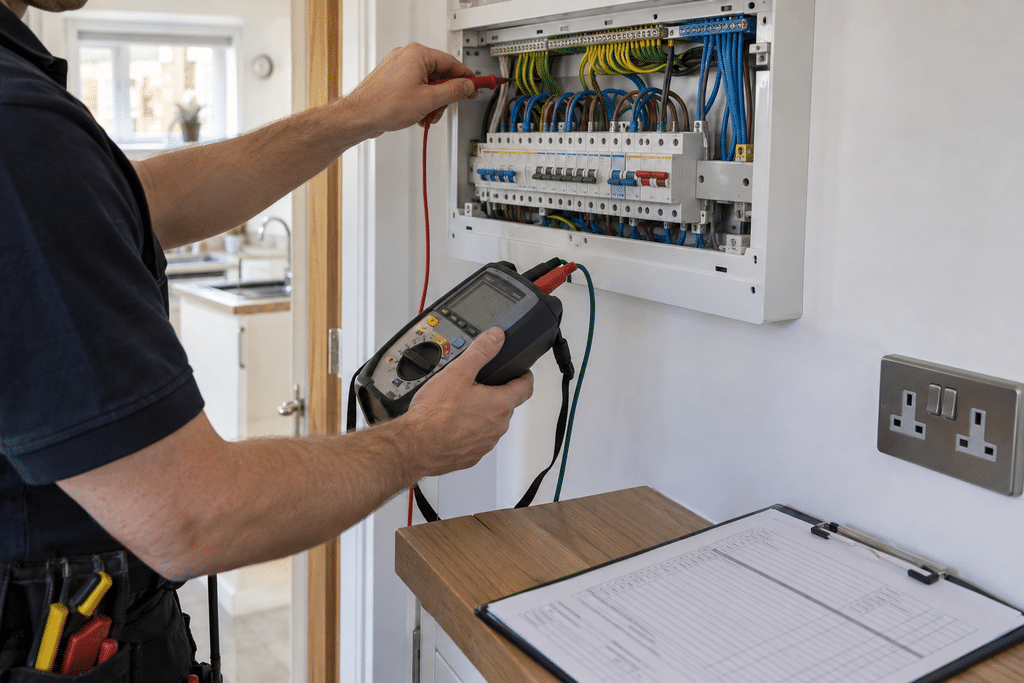
During fixed wire testing, a qualified person inspects the condition of the installation and carries out appropriate electrical tests to identify defects, deterioration and potentially dangerous conditions. The inspection ultimately produces an EICR documenting the condition of the installation and any observations requiring attention.
Testing will vary according to the property and installation, but the process can involve visual inspection and tests relating to matters such as continuity, insulation resistance, earthing arrangements and protective devices.
The electrician may also identify evidence of overloaded circuits, damaged wiring, inadequate protection, deterioration or previous electrical work that requires further investigation.
Some testing requires circuits to be isolated. For a commercial property, this makes planning particularly important.
Facilities managers and business owners should discuss access and operational requirements before testing begins so that isolation can be planned around critical equipment and business operations where practicable.
What Do C1, C2, C3 and FI Mean on an EICR?
An EICR uses classification codes to communicate the significance of observations. C1 indicates danger is present, C2 identifies a potentially dangerous condition, C3 recommends an improvement, and FI means further investigation is required without delay.
Understanding those codes makes it much easier to decide what happens after electrical safety testing.
C1 — Danger Present
A C1 observation indicates an immediate danger and risk of injury. Immediate action is required to make the situation safe.
C2 — Potentially Dangerous
C2 means a potentially dangerous condition has been identified. Remedial work is required.
C3 — Improvement Recommended
C3 indicates that an improvement is recommended. A C3 observation alone does not make an EICR unsatisfactory.
FI — Further Investigation Required
FI means the inspector cannot fully determine the safety of an issue from the initial inspection and further investigation is required without delay.
For landlords covered by the regulations in England, C1 and C2 observations require remedial work, while FI requires further investigation.
An EICR should therefore be treated as a practical safety report, not simply paperwork to be filed until the next inspection.
What Happens If Fixed Wire Testing Finds Electrical Faults?
If fixed wire testing identifies faults, the next step depends on their severity and classification. Some defects require immediate action, while others need planned remedial work, further investigation or are recorded as recommended improvements.
For example, a potentially dangerous defect may require electrical repairs or replacement of a component. An FI observation may require electrical fault finding before the necessary solution can be established.
Where extensive deterioration is identified, remedial work could be more substantial. However, an unsatisfactory EICR does not automatically mean an entire installation needs replacing.
A qualified electrician should identify the relevant defects and determine the appropriate corrective work.
For landlords in England, current government guidance requires remedial or investigative work identified under the regulations to be completed within the required timescale.
How Often Should Fixed Wiring Be Tested?
There is no single inspection frequency suitable for every electrical installation. Landlords within scope in England must arrange inspection and testing at least every five years, while commercial testing frequency should reflect the installation, environment, use, previous findings and applicable safety duties.
The date stated on the previous EICR is an important starting point.
More frequent testing or an earlier electrical safety inspection may also be appropriate where:
- The previous report recommends an earlier inspection
- The installation is subject to particularly demanding conditions
- Significant alterations have been made
- Electrical faults keep occurring
- There has been damage, flooding or another incident affecting the electrics
- The dutyholder has reason to question the installation’s safety
Regular fixed wire testing should form part of a wider approach to maintaining electrical systems rather than being treated as a once-every-five-years administrative exercise.
Is Fixed Wire Testing the Same as PAT Testing?
No. Fixed wire testing assesses the permanent electrical installation, whereas PAT testing concerns electrical equipment. They address different parts of electrical safety and one should not automatically be treated as a replacement for the other.
An EICR can assess fixed wiring, circuits, distribution equipment and associated parts of an electrical installation.
PAT testing and other checks can be used for electrical equipment according to the circumstances and applicable responsibilities.
For organisations managing offices, schools, retail premises or other commercial property, both fixed electrical systems and electrical equipment may therefore need to form part of the overall electrical safety programme.
How Long Does Fixed Wire Testing Take?
There is no universal testing time because the duration depends on the size and complexity of the electrical installation, number of circuits, access, condition of the installation and any faults discovered during testing.
A relatively small installation will generally require less testing than a large commercial building containing multiple distribution boards and extensive electrical circuits.
Commercial premises may also require additional planning because electrical testing can involve circuit isolation.
Providing accurate information about the building, distribution boards, previous reports and operational restrictions before the appointment can help the electrician plan the testing process and minimise disruption.
TNS Electrical Solutions offers EICR inspections for landlords, offices, HMOs, schools, public buildings and commercial units across London, with support for retesting and compliance queries.
Who Should Carry Out an EICR?
An EICR should be completed by a person with the competence necessary to carry out electrical inspection and testing correctly. For landlords covered by England’s electrical safety regulations, the legislation requires inspection and testing by a qualified person who is competent to undertake the work.
Electrical inspection involves more than visually checking sockets and light fittings. The person carrying out the work needs the appropriate knowledge, skills, testing equipment and understanding of electrical installations and BS 7671.
TNS Electrical Solutions provides EICR testing and electrical inspection services across London. Its website states that its team includes NICEIC-approved/certified electricians and provides services for residential, rental and commercial electrical installations.
Arrange Fixed Wire Testing in London
If your next electrical inspection is approaching, arranging testing before the deadline gives you more time to understand the condition of the installation and organise any remedial work that may be required.
TNS Electrical Solutions provides EICR testing in London for landlords, property managers and businesses, including offices, HMOs, schools, public buildings and commercial units. The company is based in Fulham and provides electrical services across areas of West and Central London, including Chelsea, Kensington, Wandsworth, Hammersmith and Westminster.
If an inspection identifies electrical faults, TNS also provides electrical installation, maintenance and repair services, allowing the findings of the report to be assessed and appropriate remedial work arranged.
For property managers responsible for multiple sites, keeping the current EICR, remedial certificates and next-inspection date together can also make ongoing electrical compliance easier to manage.
If your five-year inspection is due or you need advice about fixed wire testing for a commercial property, contact TNS Electrical Solutions to request an EICR quote.
Disclaimer: This article provides general information about electrical safety and regulatory requirements and is not a substitute for property-specific professional or legal advice. Electrical safety requirements can vary according to property type, occupation, location and circumstances. Always use an appropriately qualified and competent person and check the current regulations and guidance applicable to your property.